Posted on

The Gold Market, Part 6

The Gold Market
Part 6
by J. Orlin Grabbe

Hedging is the process of substituting a certain, or known, outcome for an uncertain one. A gold producer, for example, does not know what the spot price of gold will be a year from now. But he can hedge future gold sales by selling gold forward at the known one-year forward price. This will enable him to determine his cash flow in advance– at least that part of it that depends on the fluctuating price of spot gold. It will simplify financial planning.

The actual spot price of gold a year from now may be higher than the preagreed forward rate, or it may be lower. Thus, by hedging and substituting a known price for an unknown one, the gold producer could just as easily suffer an opportunity loss as an opportunity gain.

Many in the gold market are looking not for a fixed forward price, but rather for a boundary guarantee. A future seller of gold might want a guarantee that the sales price will not fall beyond a minimum level below which he could not tolerably live, but otherwise prefer to remain unhedged in hopes the market price will rise. Similarly, a future gold buyer might look for a guarantee that the purchase price will not rise above a tolerable maximum level, but otherwise prefer to remain unhedged in hopes the market price will fall.

What can be said of the gold price can be said of gold interest rates. A future borrower of gold might look for insurance that the borrowing rate will not be too high, while a future lender of gold might look for insurance that the lending rate will not fall below a level yielding an acceptable return.

The gold market creates and sells such guarantee or insurance contracts. In the financial literature (and in the market), these same contracts are also called options. Naturally the market does not provide such insurance contracts for free. Like anything else, they are available for a price. The price or amount paid for an option (or guarantee or insurance) is called the premium. Options trade over-the-counter and at organized securities and futures exchanges.

Just as there are natural buyers of insurance, such as gold mining companies, there are natural writers of insurance. Central banks with large holdings of gold have written thousands of options over the past decade. Along with gold lending, this activity provides an income to the banks even when the gold price does not move much.

Options have the mystique of being a very arcane subject. But there is nothing terribly difficult about them, really. All that you need to know about options can be gotten by thinking through the consequences of the terms of the options contracts themselves. The option mystique comes from the use of a not-commonly-understood branch of mathematics called stochastic calculus in order to price them mathematically, and to produce numerical computer programs to generate prices and associated statistics for trading and risk-management purposes. But those same traders and risk-managers who use the output of the programs rarely know anything about stochastic calculus. It’s simply not necessary for understanding options.

Option Terminology

Options are usually classified according to whether they are options to buy (calls) or options to sell (puts), and according to whether they can be used only on a specific date (European) or at any time prior to a specific date (American). The terms “European” and “American” refer to types of options and have nothing to do with the geographical location of trading or the manner in which prices are quoted. We will divide gold options into two further categories: options on spot gold, and options on gold futures.

Options on Spot Gold

An American gold call is a contract between a buyer and a writer whereby the call buyer pays a price (the “premium”) to the writer in order to acquire the right, but not the obligation, to purchase a given amount (“size”) of gold from the writer at a purchase price (the “exercise” or “strike” price) stated in terms of a (usually) fiat currency, on or before a stated date (the “expiration” or “maturity” date). For example, a call option on gold might give one the right to purchase two tons of gold of .995 fineness at $310/oz. on or at any time before the third Wednesday in December 1999.

An American gold put is similar, except that it gives the right to sell a given amount of gold. For example, such a put option might give one the right to sell 40,000 ozs. of gold of .9999 fineness for $285/oz. on or before June 13, 2000.

A European option differs from an American option in that it may be exercised (used) only on the expiration date. If the call option in the penultimate paragraph were European, then it could be exercised only on, but not prior to, the third Wednesday in December 1999. If the put option in the preceding paragraph were European, it could be exercised only on June 13, 2000.

There are two sides to every option contract. There is the buyer of the option, who purchases the right either to buy (call) or sell (put) the asset contained in the option contract, and there is the writer of the option, who sells the right either to buy or sell the asset contained in the option contract. The buyer of an option on spot pays the price (or premium) of the option up front, and subsequently has the right to exercise or not to exercise the option contract. For example, the buyer might pay $20,000 to purchase a put that allows the buyer to sell 25,000 ozs. of gold at a strike price of $280/oz. The other side of the put contract is the writer who sells this right. The writer receives the $20,000 premium the buyer pays. Then if the buyer decides to exercise the right to sell 25,000 ozs. of gold, the writer has to purchase the gold at $280/oz. from the buyer of the put option. The buyer might be, for example, a Nevada gold-mining company and the writer a U.S. bank. If the bank writes the put to the company, and then the company exercises its right to sell gold at the strike price of $280/oz., the bank has to accept the 25,000 ozs. of gold and pay the company $7,000,000 in return.

Options on Gold Futures

Options on gold futures contracts, such as those traded at the COMEX Division of the New York Mercantile Exchange, are somewhat different from options on spot gold. A call on gold futures is a contract between a buyer and a writer whereby the call buyer pays a price (the premium) to the writer in order to acquire the right, but not the obligation, to go long an exchange-traded gold futures contract at an opening price (the strike price) stated in terms of a fiat currency. If the buyer of a call on futures exercises his or her right to go long a futures contract, the writer of the option must go short the futures contract. A put on gold futures similarly gives the right to establish a short position in an gold futures contract at a price given by the exercise price of the option. If the buyer of a put on futures exercises his or her right to go short a futures contract, the writer of the option must go long the futures contract.

(For credit purposes, the futures clearinghouse becomes the effective counterparty in all futures option trades. The clearhouse in effect becomes the writer to every option buyer, and the buyer to every option writer. But this does not change any of the contractual obligations associated with an option. In particular, the clearinghouse does not itself exercise long option positions. If the holder of a long option (put or call) exercises the option, the clearinghouse picks someone who is short the same option contract to meet the contractual obligation.)

All currently traded options on gold futures contracts are American in type, and can be exercised on any business day prior to expiration. For example, if you have an American call on December gold futures with a strike price of $280/oz. and the current futures price is $283.50/oz., exercising the option will give you a long position of one December gold futures contract at an opening futures price of $280/oz. Since the current futures price is $283.50/oz., the value of this futures position is

$283.50/oz. – $280/oz. = $3.50/oz.

This profit can be realized immediately by closing out the futures position (going short to offset), or by withdrawing the cash from the account (if futures margin requirements are otherwise already met).
Definition Summary

At this point a short summary of the basic option definitions might be useful:

1. There are two sides to each option contract--the buyer who obtains the option right to exercise, and the writer who issues this right.

2. From the buyer's perspective, a call is an option to buy or go long, while a put is an option to sell or go short.

3. From the writer's perspective, a call is an obligation to sell or go short (if the call buyer exercises), while a put is an obligation to buy or go long (if the put buyer exercises).

4. An option on spot gold involves an up-front cash payment of the premium from the buyer to the writer, and in addition a subsequent exchange of gold for a fiat currency if the buyer exercises the option.

5. An option on futures involves an up-front cash payment of the premium from the buyer to the writer, and in addition a subsequent futures position in which the buyer and writer are on opposite sides if the buyer exercises the option.

6. Any of these options can be American or European. The option is European if it can only be exercised on the final day, the expiration day. An American option can also be exercised on any business day prior to expiration. 

Gold Options as Insurance

Let’s look at the use of gold options for hedging from the point of view of an option buyer. For the moment, we will simply treat options as contracts that are available to the buyer or the writer at a market-determined price, without concerning ourselves with the separate question of what the fair value (fair to both the buyer and writer) of a gold option is.

For the purpose of hedging, gold options can be viewed as price insurance. Consider how insurance works in general. Suppose you buy fire insurance on a $100,000 house. You insure the house for its full value of $100,000, and the insurance is good for one year. If, by the end of the year, your house has not been damaged by fire, the insurance will have proved worthless. You throw away the unused insurance policy. Your total cost has been the cost of the insurance premium. On the other hand, suppose that fire does $40,000 worth of damage to your house. In this case, you have a $40,000 loss. But the insurance policy pays off the difference between the amount of the insurance ($100,000) and the current value of the insured asset ($60,000), making up exactly the amount of your loss ($40,000). Thus your total loss is zero, except again for the insurance premium, which you pay in any case.

An option works in the same way. Suppose you buy a put option on the value of a house. In particular, suppose the strike price of the put is $100,000. That is, it gives you the right to sell the house for $100,000. You buy an American put (so that it can be used at any time), and it expires in one year. If the market value of the house stays at $100,000 or greater for the year, there would be no advantage in exercising the put. Thus the put would expire worthless. You would throw it away rather than use it to your disadvantage.

But if, because of fire or for some other reason, the value of the house dropped to $60,000, you could exercise the put and sell the house for $100,000. The put has then served as insurance. It paid off the difference between the strike price ($100,000) and the current value of the house ($60,000), thus making up the entire loss in value ($40,000). In any case, whether or not the house lost value, you pay the cost of the put. The price paid for an option is (conveniently) referred to in the options market as the premium and is analogous to an insurance premium. Overall, then, the put serves as an insurance policy. (Or, as some prefer to say, insurance itself is just a put option.)

Let’s extend the analogy to deductible insurance. Suppose that, instead of insuring your house for $100,000, you insured it for $80,000. In this case if your house is damaged by fire, you will have to bear the loss of the first $20,000. On the other hand, the insurance premium on $80,000 will be less than the premium on $100,000, so that you may be willing to trade off the greater risk of loss in the case of fire with the lower fixed cost of the insurance premium. In the same way, if you purchased a put option on the house with a strike price of $80,000 instead of a strike price of $100,000, the premium (purchase price) of the put would be lower. But the insurance level of the put will be lower, because it will only pay to exercise the put if the value of the house falls below $80,000. Thus, buying a put option with a strike price that is lower than the current market value of the asset involved is like buying deductible insurance. Whether you like deductible insurance depends on your attitude to trading off lower insurance premiums with the risk of greater loss in the event disaster strikes.

Both options on spot gold and options on gold futures can be considered types of insurance against adverse gold price movements. Options on spot gold represent insurance bought or written on the spot price, while options on gold futures represent insurance bought or written on the futures price (which, as we saw in earlier parts of this series, is equivalent to the forward price).

Floors and Ceilings

An individual with gold to sell can use put options on spot gold to establish a floor price on the fiat currency value of gold. For example, a put option on 1 oz. of gold with an exercise price of $300/oz. will ensure that, in the event the value of gold falls below $300/oz., the 1 oz. of gold can be sold for $300/oz. anyway. If the put option costs $3/oz., this floor price can be roughly approximated as

$300/oz. – $3/oz. = $297/oz.,

or the strike price minus the premium. That is, if the option is used, you will be able to sell the 1 oz. of gold for the $300/oz. strike price, but in the meantime you have paid a premium of $3/oz.. Deducting the cost of the premium leaves $297/oz. as the floor price established by the purchase of the put. (This ignores fees and interest rate adjustments.)

Similarly, an individual who has to buy gold at some point in the future can use call options on spot gold to establish a ceiling price on the fiat currency amount that will have to be paid to purchase the gold. For example, a call option on 1 oz. with an exercise price of $305/oz. will ensure that, in the event the value of gold rises above $305/oz., the 1 oz. can be bought for $305/oz. anyway. If the call option costs $1/oz., this ceiling price can be approximated as

$305/oz. + $1/oz. = $306/oz.,

or the strike price plus the premium. To summarize these two important points involving gold puts and calls:

  1. Gold put options can be used as insurance to establish a floor on the fiat currency value of gold. This floor price is approximately

Floor price = Exercise price of put – Put premium.

  1. Gold call options can be used as insurance to establish a ceiling on the fiat currency cost of gold. This ceiling price is approximately

Ceiling price = Exercise price of call + Call premium.

These calculations are only approximate for essentially two reasons. First, the exercise price and the premium of the option on spot gold cannot be added directly without an interest rate adjustment. The premium will be paid now, up front, but the exercise price (if the option is eventually exercised) will be paid later. The time difference involved in the two payment amounts implies that one of the two should be adjusted by an interest rate factor. Second, especially in the case of exchange-traded options, there may be brokerage or other expenses associated with the purchase of an option, and there may be an additional fee if the option is exercised.

Over-the-Counter Options

Gold options are dealt over-the-counter in the form of a two-way price: a bid price at which the option will be purchased, and an asked price at which the option will be sold. At the time an option is dealt, the following must be specified in addition to the premium or cost of the option:

whether the option is a put or call
the strike (exercise) price of the option
the date the option expires
the principal amount of the option (number of oz. of gold)
whether the option is American or European.

There are four dates associated with each option. The first of these is the contract date, which is the date the option is traded or dealt. Since the option premium and strike price are agreed at this time, the option is actually in existence as of this date. The next is the premium settlement date, which is the date the option premium is actually paid. This is typically two working days after the contract date–following the two-day settlement convention in the foreign exchange market. The next date is option expiration, which is the final date on which the option may be exercised–the day the insurance runs out. The fourth date is the option settlement date, which again is typically two working days after the option expiration date. If an option is exercised on the expiration date, then gold and cash will exchange hands two working days later on the option settlement date. In the event the option is American, and thus can be exercised prior to the expiration date, option settlement will be two business days after the option is exercised.

Options are typically traded over-the-counter on a month basis. Thus, an “April” option will mean an option whose settlement date is the last trading day in April. The expiration day of the option will be two business days prior to the last trading day. Such options are traded for every calendar month. (Frequently a company will want a price quotation on a strip of options; for example, a strip of 24 puts, one put for each month in the next two years.)

Let’s look at a simple example.

Example 6.1

A gold refiner wants a 290 November European put on 24,000 ozs. of gold. The marketmaker gives a quote of 2.20- 2.60. This quotation is in U.S. dollars per ounce. The first price, $2.20/oz., is the premium that the refiner will receive if he sells the put, while $2.60/oz. is the price he will pay if he purchases the put. The strike price of the option is $290/oz. The refiner buys the put for $2.60.

In two business days, the refiner will pay the marketmaker the option premium. The premium amount is

24,000 oz. x $2.60/oz. = $62,400.

Since the option is European, nothing more will happen until option expiration in November, which is two business days prior to the last trading day.

Note, however, that the refiner has assured that the selling price for gold will not be less than

$290/oz. – $2.60/oz. = $287.40/oz.

The number $287.40/oz. is the refiner’s floor price. The refiner is assured he will not receive less than this, but he could receive more. The price the refiner will actually receive will depend on the spot gold price on the November expiration date. To illustrate this, we can consider two scenarios for the spot price of gold.

Case A

Spot gold on the November expiration date is $296/oz. The refiner would not use the put option (which has a $290 strike price) but would sell gold spot at the higher market rate of $296/oz. (Settlement will take place two days later.)

The total amount received per oz. of gold, once we subtract the cost of insurance, is

$296 – $2.60 = $293.40.

The $2.60/oz. that was the original cost of the put turned out in this case to be an unnecessary expense.

Now, to be strictly correct, a further adjustment to the calculation should be made. Namely, the $296 and $2.60 represent cash flows at two different times. Thus, if x is the amount of interest paid per dollar over the time period to end November, the proper calculation is

$296 – $2.60(1 + x).

Case B

The spot rate on the November payment date is $284/oz. The refiner can either exercise his option or sell it back to the marketmaker for its market value of $6/oz. Assuming the refiner exercises the option, he sells 24,000 oz. of gold for

($290/oz.)(24,000 oz.) = $6,960,000.

Subtracting the premium paid earlier, the net amount is

$6,960,000 – $62,400 = $6,897,600 .

This, of course, works out to be $287.40/oz., the floor price established by the option. (Here we have ignored the interest opportunity cost on the $62,400 premium.)

Writing Gold Options

The writer of a gold option on spot or futures is in a different position from the buyer of one of these options. The buyer pays the premium up front and afterward can choose to exercise the option or not. The buyer is not a source of credit risk once the premium has been paid. The writer is a source of credit risk, however, because the writer has promised either to sell or to buy gold if the buyer exercises his option. The writer could default on the promise to sell gold if the writer did not have sufficient gold available, or could default on the promise to buy gold if the writer did not have sufficient cash available.

If the option is written by a bank, this risk of default may be small, depending on which bank in which country. But if the option is written by a company, the bank may require the company to post margin or other security as a hedge against default risk. For exchange-traded options, as noted previously, the relevant clearinghouse guarantees fulfillment of both sides of the option contract. The clearinghouse covers its own risk, however, by requiring the writer of an option to post margin. At the COMEX, for example, the clearinghouse will allow a writer to meet margin requirements by having the actual gold or U.S. dollars on deposit, by obtaining an irrevocable letter of credit from a suitable bank, or by posting margin in the form of Treasury securities.

From the point of view of a company or individual, writing options is a form of risk-exposure management of importance equal to that of buying options. It may make perfectly good sense for a company to sell gold insurance in the form of writing gold calls or puts. The choice of strike price on a written option reflects a straightforward trade- off. Gold call options with a lower strike price will be more valuable than those with a higher strike price. Hence the premiums the option writer will receive are correspondingly larger. However, the probability that the written calls will be exercised by the buyer is also higher for calls with a lower strike price than for those with a higher strike. Hence the larger premiums received reflect greater risk taking on the part of the insurance seller (the option writer).

(Back to Index)

This article appeared in Laissez Faire City Times, Vol 2, No 26.
Web Page: http://www.aci.net/kalliste/

-30-
Posted on

The Gold Market, Part 5

The Gold Market
Part 5
by J. Orlin Grabbe

Interest rates in the gold market are a principal concern of gold dealers and gold mining companies.

In Parts 3 and 4, we saw how two interest rates– gold lease rates and eurodollar rates–determine the relationship between the dollar price of spot gold and the dollar price of gold forwards and futures. In the forward market, these two interest rates give rise to the swap rate, while in the futures market they determine the EFP price. Both swaps and EFPs involve a spot sale or purchase of gold, along with the reverse trade in the forward market (if a swap) or futures market (if an EFP).

Because eurodollar rates have historically always exceeded gold lease rates, gold forward and futures have always traded at a premium (have always been in contango). There is nothing inevitable about this relationship, however.

But there are many contracts in the gold market that do not involve the spot, forward or future price of gold, but rather are simply written in terms of gold interest rates. These include gold forward rate agreements (FRAs), gold interest rate swaps, and gold interest rate guarantees (IRGs). Let’s examine each of these contracts in turn.

Gold FRAs

A gold forward rate agreement (FRA) is a contract whose payout depends on whether the market interest rate diverges from an agreed “contract rate”. It is called a “forward rate” agreement, because the interest rate applies to a gold deposit or loan starting at some time period in the future. That is, the interest rate in question is the gold lease rate (also called gold libor). Recall that we used the gold “lease” rate as a generic term to refer to both the bid rate for taking in gold deposits and the offer rate for making gold loans. Recall also that the interest in this case is typically paid or received as so many ounces of gold. Similarly, a gold FRA will be typically settled with one party paying the other in gold.

A typical FRA contract in this regard might be a gold deposit that begins three months from today, and lasts for three months (ending six months from today). This would be called a 3 vs. 6 FRA. The terminology “3 vs. 6” implies the contract starts in 3 months and ends in 6 months.

What is agreed to is a contractual interest rate: the FRA rate. If the actual realized market rate turns out to differ from the FRA rate (as it almost inevitably will), then one makes or receives payment depending on the terms of the contract.

There are five principal parts to an FRA contract: the contract rate, the notional amount of gold in a contract, the fixing date when the market interest rate is compared to the contract rate, the start date of the deposit (or loan), and the maturity date of the deposit (loan).

One can buy or sell this contract. The settlement amount S paid to the buyer of the FRA from the seller is calculated as follows:

S = notional amount x (market rate – contract rate) x (days in period)/360.

If the market rate is below the contract rate, so that the sign on the amount S is negative, then the FRA buyer pays the FRA seller the absolute value of S.

The calculation above assumes that payment is made at the end of the FRA period (on the maturity date). But if (as is normally the case) payment is made on the start date instead, the settlement amount S given above is discounted by the market rate at which the contract was settled:

S/[1 + market rate x (days in period)/360].

Let’s do an example.

Example: Consider a depositor who will have one ton (32,000 ounces) of gold available in 3 months, but will not be utilizing the gold for another 3 months after that. He wants to lock in the interest rate he will receive on his gold deposit now. He asks for a quote of the 3 vs. 6 months FRA, and receives the quotation:

    3 vs. 6 FRA 1.50-1.80 % 

This quotation means he can "sell" the FRA at a contract rate of 1.50 percent (.015), or "buy" the FRA at a contract rate of 1.80 percent.

So, in this case, he sells the FRA with a contract rate of 1.50, and a notional amount of 32,000 ounces of gold.

Three months from today, on the fixing date, he will determine the best market rate available, and this will be compared to the contract rate to determine the FRA settlement amount. (The fixing date will typically be two business days prior to the conceptual start date of the deposit or loan.) Suppose the best deposit rate at that time is 1.00 percent (.01). Suppose also that the three- month deposit period from start date to maturity date is 92 days. The settlement amount S is then calculated as:

S = 32,000 x (.01-.015) x (92/360) = - 40.889 oz.

The sign here is negative, which means the FRA buyer pays the FRA seller (our hypothetical depositor) 40.889 oz. of gold on the maturity date (if payment is made then). If payment is made on the start date, it is discounted by the time period of the deposit:

40.889/[1+.01 x (92/360)] = 40.785 oz.

So in this event the FRA buyer pays the FRA seller 40.785 oz. of gold on the start date.

Now if the depositor deposits his ton of gold at the market rate of 1.00 percent for three months, he will end up with an equivalent interest rate of 1.50 percent, the FRA rate, because the difference has been paid out on the FRA contract.

The same would have been true if the depositor had lost, rather than gained, from the FRA contract. For in that case the market rate paid on deposits would be higher than 1.50 percent, but the depositor would lose the difference on the FRA contract. 

Similar examples could be done for gold borrowers. Gold borrowers typically borrow at the gold lease (gold libor) rate plus a margin: say

market rate + .75%

and make periodic gold interest payments at intervals of 6 months. By using FRAs for 6 month intervals (such as 6 vs. 12, 12 vs. 18, 18 vs. 24, etc.), the next few interest payments on this loan can be locked in as

FRA rate + .75%

if that seems desirable.

Gold Interest Rate Swaps

It is important not to get the word “swap” as used here confused with “swap” in the gold forward market. There the term referred to the relationship between spot and forward prices. Here, in “interest rate swap,” we are referring to a trade of a fixed interest rate for a floating interest rate.

The swap “buyer” in an interest rate swap agrees to pay a fixed interest rate to another party, and in return receives at periodic intervals an interest rate that fluctuates (floats) with the market. That is, the buyer pays a fixed gold rate and receives the market- determined gold lease rate (or some equivalent).

The other side of the interest rate swap contract is the seller who receives fixed and pays floating.

If, for example, the floating rate is the 3-month gold lease rate, then every 3 months there will be a net interest payment whenever the market lease rate diverges from the fixed rate. If the market rate is above the fixed rate, then the swap buyer (who pays fixed) will receive an interest payment representing the positive net difference of floating minus fixed. If the market rate is below the fixed rate, then the swap seller (who receives fixed) will receive an interest payment representing the positive net difference of fixed minus floating.

In essence, then, a gold interest rate swap is just a series of gold FRAs. If the floating rate in the market is above the fixed rate, the swap buyer (who pays fixed) is in the same positon as the buyer of an FRA. If we equate the “fixed rate” with the “contract rate” in an FRA, then the FRA buyer receives a positive cash flow if the market rate is above the fixed rate.

So buying a gold interest rate swap represents the purchase of a series of gold FRAs at a single contract rate (fixed rate), while selling a gold interest rate swap represents the sale of a series of gold FRAs at a single contract rate (fixed rate).

Why would someone want to do this? Let’s consider an example.

Example: Consolidated Gold Nuggets has an existing loan of 1 million ozs. of gold with two years remaining to maturity. It pays floating interest at the 3-month gold lease rate plus a margin of 1.75 percent. However, gold lease rates have fallen, and the treasurer wishes to lock in a low fixed rate. Renegotiating the loan will involve contractual penalties. The treasurer shops the market and determines she can buy a two- year gold interest rate swap, paying 2 percent fixed against the floating 3-month gold lease rate flat. She does the swap.

Her swap payments are

2% - 3-month gold lease.

Her loan payments are

3-month gold lease + 1.75%.

The net interest payment is the sum of these:

2% + 1.75% = 3.75% .

So by doing the gold interest rate swap, she has turned the floating rate loan into a fixed rate loan of 3.75 percent. 

Gold Interest Rate Guarantees

Gold IRGs are a form of insurance. Typically they take the form of a floating rate, with a guaranteed maximum or minimum. The gold borrower might prefer to borrow floating, and hence have the ability to profit from falling interest rates, but nevertheless want a guarantee that the floating rate paid will not rise above some maximum or ceiling level.

In a similar vein, a gold lender might prefer to lend at floating rates, in order to profit from rising interest rates, but desire a guarantee that the rate received will not fall below some minimum or floor level.

These types of guarantee contracts are analytically equivalent to interest rate options. Hence we will defer their discussion until we have discussed options in general in the context of options on the gold price.

(to be continued)

This article appeared in Laissez Faire City Times, Vol 2, No 22.
Web Page: http://www.aci.net/kalliste/

-30-
Posted on

The Gold Market, Part 4

The Gold Market
Part 4
by J. Orlin Grabbe

“There’s been a bomb at the World Trade Center.”

We all looked over at Kelley, one of the gold traders. She was quoting the Telerate news ticker off the monitor on her desk. There was no further information.

We then looked past Kelley, out the seventh floor windows of 222 Broadway, and down the half block of a side street to No. 4 World Trade Center (WTC). The COMEX, where gold futures are traded, was on the 8th floor of No. 4 WTC, and Kelley and one of the other gold traders had open phones lines to the trading floor.

The background voices at the COMEX, heard over the speakers where we were, sounded normal. The street scene outside looked normal also.

“Why don’t you ask the floor if there’s anything unusual over there,” I suggested to Kelley. We had two brokers on the COMEX floor.

Nothing out of the ordinary, they said. No bomb here. One opined he had felt a small shake of the building. The other one hadn’t noticed even that.

Those of us at 222 Broadway went back to work, filing away this interesting, but seemingly irrelevant piece of information: a bomb at the World Trade Center. It was, in fact, another hour before smoke began to fill the elevators at No. 4 WTC, and COMEX traders were ordered to evacuate the building. In the meantime, Kelley kept us updated as more news hit the ticker.

“It was centered in the garage area,” she announced.

For the first time, someone looked concerned. “I’m parked over there,” he said.

Tom wandered by my desk. “Want to go take a look?” he asked. Tom was a PhD chemist who had turned option trader. He had a natural curiosity about explosions.

I declined the invitation. Where there is one bomb, there may be two, and I preferred to wait until the excitement was over. If the bomb was in the parking garage, I doubted there was anything to see, anyway. Tom shrugged and left by himself. He returned with a report: the bomb had collapsed the lobby floor of the Vista Hotel on the ground floor of the tower at No. 1 WTC, as well as the floor below that, and a 20- foot crater now extended out to the street beside the tower. From our windows, we couldn’t see the activity taking place because No. 4 WTC blocked our view. I reflected that I had passed through the Vista Hotel lobby the previous day, en route to the walkway connecting the World Trade Center to the World Financial Center located on the other (wharf) side of Manhattan’s Westside Highway.

As it turned out, the WTC bomb had been planted by an FBI informant, whose FBI handler had insisted he use real explosives, and not fake that part of the “sting”. This was reported in the New York Times before Louis Freeh’s media handlers went to work and quashed reports of the FBI connection, and diverted all attention to the supposedly purely foreign nature of the “Middle Eastern terrorists” (with U.S. intelligence connections) whose operation the FBI had been assisting under the guise of conducting a “terrorist sting”.

It was claimed the bombers had intended to bring down the tower at No. 1 WTC. Though in fact the van filled with explosive (alleged, but not shown, to be urea nitrate) had done no damage to the building structure. Explosive pressure drops off approximately with the cube of the distance, so to do serious damage with a low-power explosive, you need to attached it to the building columns.

What the explosion had done was to take out two floors in a particular area vertical to the van location, and to fill the building cavities with smoke. Most of the 1000 or so injuries resulted from smoke inhalation, and were basically confined to those taking the commuter trains from New Jersey into the train station in the basement of the WTC. That is, to passers-through trapped in smoke, and not to people actually working at the WTC.

By the end of the day, Tom and I were discussing ANFO bombs instead of options. Where I had grown up in Texas, ammonium nitrate was widely used as fertilizer. It was just one of those things prevalent in the environment, like gasoline and butane, that you used and treated with respect. I had never known anyone killed with ammonium nitrate, although I had known two people, including one neighbor, who had blown themselves up welding “empty” butane tanks.

No, the FBI-assisted terrorists hadn’t done much damage to the World Trade Center, relatively speaking, aside from the Vista Hotel. But for a few hours on Feb. 26, 1993, they had shut down the COMEX, and– London trading having finished for the day–most of the world’s gold market along with it.

Gold Futures

Gold futures are traded at the COMEX in New York (which merged with the NYMEX on August 3, 1994, and is now known as the “COMEX Division” of the New York Mercantile Exchange), at the TOCOM in Tokyo, and–until recently– at the SIMEX in Singapore. Gold futures are also traded at the Chicago Board of Trade (CBOT) and at the Istanbul Gold Exchange. (The latter is mostly a market for spot gold. For example, over 8 million ounces of gold were traded spot at the Istanbul Gold Exchange in 1997, but only about 43,000 ounces were traded through the futures market.)

Gold futures are priced much like the gold forwards we discussed in part 3. That is, in their relationship to the spot price, futures show little difference from forwards. But there are many other ways in which futures contracts differ from forwards, and it is important to understand what these are.

Forward gold is traded for contract settlement at standardized intervals from spot settlement, in intervals that correspond to foreign exchange forward contracts: 1, 2, 3, 6, and 12-month forwards are typical. Spot gold traded on Wednesday June 24 will settle on Friday, June 26. A one-month forward trade on June 24 will take us to July 26, which is a Sunday, so settlement of a one-month forward will be on Monday, July 27. A two-month forward trade on June 24 will take us to August 26, which is a Wednesday, so settlement of a two-month forward contract will be on August 26. And so on.

Futures, by contrast, are traded for fixed dates in the future. At the COMEX and CBOT, gold is traded for settlement in February, April, June, August, October, and December, as well as the current and next two calendar months. Istanbul trades the next six months for Turkish lira-denominated contracts, or the next 12 months for U.S. dollar-denominated contracts. The last trading day for a futures contract is the fourth to last business day in the delivery month (at the CBOT or Istanbul), or the third to last business day (at the COMEX). That is, the August 1998 COMEX gold future trades until the third to last business day in August 1998. At the TOCOM, there are futures for the current or next odd month, and all even months within a year. The last trading day is the third to last business day, except for December, when the last trading day is December 24.

Despite the different trade date conventions, however, if futures and forward settlement dates happen to correspond, forward and futures prices are the same, subject to slight differences related to delivery grade or location (Manhattan, say, versus London).

How Futures Markets Deal with Credit Risk

The main different between futures and forwards is the way futures markets handle credit risk. In the forward market, a credit evaluation must be made of the counterparty–evaluating the counterparty’s ability to pay cash if gold was purchased forward, or the ability to deliver the gold, if gold was sold forward.

The futures market don’t worry about such customer credit evaluations. Instead, a futures contract is configured as a pure bet, based on price change. So one is asked to post a security bond, called “margin”, which covers the typical variation in the value of a contract for several days. Going long a futures contract is a bet that the price is going up, while going short is a bet the price is going down. Cash flows from price changes take place daily. So those who post the required margin against possible losses (and who replenish this margin if necessary) are considered credit-worthy, while those who can’t post margin aren’t credit-worthy. Customers post margin with member firms of the futures exchange, who in turn post margin with clearing member firms. The clearing member firms post margin (on the customer’s behalf) at a clearinghouse. This way of dealing with credit risk is a much cleaner structure than in the forward market world of customer credit evaluations, accounting reports, and other types of intrusive financial reporting. (Of course, exchange member firms and, especially, clearing member firms still have to undergo the usual sorts of credit checks.)

To close out a long position, one sells (goes short) an off-setting contract. To close out a short position, one buys (goes long) an off-setting contract. The opening and subsequent closing of a futures position is referred to as a “round turn”. Brokerage fees are usually charged per round turn, at the time the future contract is closed out.

At discount brokerage firms in the U.S., in June 1998, the typical customer margin on a 100 oz. gold futures contract was about $1350, while there was a typical brokerage charge of $25 per round turn.

The size of the futures bet depends on the stated size of the futures contract. The cash flow will be the change in price multiplied by the contract size.

At the COMEX, CBOT, and the SIMEX, the contract size is 100 ozs of gold with a fineness of .995. So if gold (of that fineness) went from $299/oz at contract opening to $297.50/oz as the day’s futures settlement price, a long contract would lose $150, while a short contract would gain $150. (The calculation on the short position is $299 minus $297.50, multiplied by 100.)

The TOCOM trades 1 kilo bars (32.148 ozs) of .9999 fineness. The price is stated as yen/gram. So the daily change in value of a single contract is the change in the yen price per gram, multiplied by 1000 grams.

The Istanbul gold futures contract is for 3 kilograms of gold of .995 fineness, quoted either in terms of U.S. dollars per ounce, or Turkish lira per gram. The daily change in value of a U.S. dollar- denominated contract is the change in dollars per oz, multiplied by 96.444 ozs. The daily change in value of a Turkish lira-denominated contract is the change in the Turkish lira price per gram, multiplied by 3000 grams.

The “initial” margin that must be posted as a security bond is large enough to cover several days expected/loss or gain, and is thus related to the standard deviation of daily contract value changes. The margin is held by a clearinghouse which thus “guarantees” that the losing side of the daily futures bet pays the winning side. For every customer that goes long a contract, the clearinghouse takes the other side, going short. For every customer that goes short a contract, the clearinghouse takes the other side, going long. The clearinghouse thus is in a position to move cash from the losing side of any futures bet to the winning side.

If the initial margin is depleted by losses, it eventually reaches a “maintenance” margin level, below which the customer is required to replenish the margin to its initial level. For example, at discount brokerage firms in the U.S. in June 1998, a typical maintenance margin level for gold futures contracts at the COMEX was $1000 per contract. So if the posted margin dropped below $1000 per futures contract, additional margin had to be posted to bring the total back to at least $1350 per contract (the typical initial margin level).

Customers typically may post margin in the form of cash, or U.S. government securities with less than 10 years to maturity. Clearing members may post cash, government securities, or letters of credit with the clearinghouse. The details differ at different exchanges.

The Equilibrium Futures Price

The equilibrium futures price is that point where the market clears between longs and shorts. Arbitrage, however, forces the futures price to track the forward price (and vice-versa). Similarly, arbitrage between the futures market and the spot market on the final day of trading forces the futures price to converge to the spot price. On the final trading day at the SIMEX, where no gold can actually be delivered on a futures contract, the settlement price is set as the loco London price of the A.M. London price fix. This forces convergent of the futures price to the price in the London spot market. At the COMEX and CBOT, the open longs take delivery of spot gold, which accomplishes the same thing.

(On January 9, 1998, the SIMEX removed trading of its gold futures contract from the floor of the exchange. The contract is still available on the SIMEX Automated Trading System.)

Delivery at the COMEX and the CBOT is one 100-oz bar (plus or minus 5 percent) or three 1-kilogram gold bars, assaying not less than .995 fineness. (Note that 3 kilo bars is about 96 ounces of gold. The dollar amount actually paid at delivery depends, of course, on the specific amount of gold delivered, which must be within 5 percent of the hypothetical 100 ozs per contract.) Delivery at the CBOT takes place by a vault receipt drawn on gold deposits made in CBOT-approved vaults in Chicago or New York. Gold delivered against futures contracts at the COMEX must bear a serial number and identifying stamp of a refiner approved by the COMEX, and made from a depository located in the Borough of Manhattan, City of New York, and licensed by the COMEX. As noted previously, there is no delivery at the SIMEX. The futures contract is purely cash- settled, with the final settlement price determined by the London A.M. gold fix.

In part 3, we saw the U.S. dollar forward price of gold would be related to the U.S. dollar spot price of gold by the relationship

F(T) = S [1 + r (T/360)] / [1 + r* (T/360)]. 

where the spot price is S, the forward (or futures) price is F(T) for a time-horizon of T days, the eurodollar rate is r, and the gold lease rate is r. If the eurodollar rate r is higher than the gold lease rate r, then the forward (futures) gold price will be higher than the spot gold price. Historically gold lease rates have always been lower than eurodollar rates, so forward gold (or a gold futures contract) always trades at a higher price than spot gold. The same is not true, for example, in the silver market. During the year 1998, silver lease rates have frequently exceeded eurodollar rates, so forward silver has traded at a cheaper price than spot silver.

Different terms are used to refer to the relationship between forward or futures prices and spot prices. If forward gold (or a gold future) has a higher price than spot gold, the forward gold or gold future is said to be at a premium, or (in the London market) in contango. If forward gold has a lower price than spot gold, the forward gold or gold future is at a discount, or (in the London market) in backwardation.

As we noted before, forward gold has in recent history always been in contango, or at a premium, because dollar interest rates have always been above gold lease rates. We saw in part 3 that the difference between the forward price and the spot price, F(T)-S, is the swap rate. Since the forward price of gold has always been at a premium in recent years (since 1980, in particular), the swap rate has always been positive. A related term that is used in the U.S. futures markets is basis. Basis is the spot price minus the futures price, or S-F(T), which is just the swap rate with the sign reversed. The gold basis has always been negative in recent years. The Federal Reserve Bank of Cleveland, for example, publishes monthly charts of the gold basis. Reverse the sign on their chart, and you are looking at the swap rate.

Exchange for Physicals

While forward gold is traded in the form of swaps, which combines a spot trade (buy or sell) with the reverse forward trade (sell or buy), gold futures can be traded in the form of EFPs (exchange for physicals), which combine a futures trade with the reverse spot trade. EFPs are traded for the same months as gold futures. The EFP price represents the difference between the futures price and the spot price for the combined trade.

For example, a marketmaker may quote the August EFP at the COMEX as $1.10-$1.30 in 100 lots. This means the marketmaker’s prices are good for a standard trade involving 100 futures contracts (10,000 ozs of gold). The marketmaker will “buy” the EFP at $1.10/oz, or “sell” the EFP for $1.30/oz.

This quotation implies that for $1.10/oz. the marketmaker offers to buy from you 100 gold futures contracts, while simultaneously selling to you 10,000 ozs of spot gold. For $1.30/oz. the marketmaker will sell to you 100 gold futures contracts, while simultaneously purchasing 10,000 ozs of spot gold. To summarize: the marketmaker’s bid price is the price he will buy futures versus selling spot, while the marketmaker’s asked price is the price he will sell futures versus buying spot. The EFP price is thus simply a different way of looking at the basis or the swap rate.

On June 24, 1998, the mid-market price (average of bid and asked prices) of the EFP associated with the August 1998 COMEX gold contract was a positive $1.25, while the mid-market price associated with the Dec 1998 COMEX gold contract was a positive $5.60. By contrast, the EFP associate with the July 1998 COMEX silver contract was a negative $2.00. This reflected the fact that gold lease rates were below eurodollar rates, while silver lease rates were above.

(to be continued)

This article appeared in Laissez Faire City Times, Vol 2, No 20.
Web Page: http://www.aci.net/kalliste/

-30-
Posted on

The Gold Market, Part 3

The Gold Market
Part 3
by J. Orlin Grabbe

Now that we have seen how spot gold is priced “loco London,” we can examine how other local markets, and other types of gold contracts, are priced in reference to the London spot market. This includes other spot delivery locations, gold forward and futures contracts–such as the gold futures contract at the NYMEX in New York– and gold swaps, forward rate agreements, and options. (In 1994 the COMEX merged with the NYMEX, and the principal gold futures contract now trades there.)

London is only one of many important centers for gold trading. The second principal center for spot or physical gold trading, for example, is Zurich. For eight hours a day, trading occurs simultaneously in London and Zurich–with Zurich normally opening, and closing, an hour earlier than London. During these hours Zurich closely rivals London in its influence over the spot price, because of the importance of the three major Swiss banks–Credit Suisse, Swiss Bank Corporation, and Union Bank of Switzerland–in the physical gold market. Each of these banks has long maintained its own refinery, often taking physical delivery of gold and processing it for other regional markets.

(On December 8, 1997, Swiss Bank Corporation and Union Bank of Switzerland announced plans to merge, the combined bank to be known as United Bank of Switzerland. The net effect such a merger would ultimately have on the Zurich gold market is not yet clear.)

In addition to other gold delivery locations, there are other weight and quality standards which create differential prices. Examples include the London and Tokyo kilobars (which are 32.148 ozs., instead of the circa 400 oz. “large bars”), the 10 tola bars (3.75 ozs.) popular in India and the Middle East, the 1, 5 and 10 tael bars (respectively 1.203, 6.017, and 12.034 ozs.) found in Hong Kong and Taiwan, and the baht bar (0.47 ozs) of Thailand. Gold content is another difference. The London good delivery bar is only required to have a minimum of 995 parts gold to 1000 parts total. But a gold content of 9,999 parts gold to 10,000 parts total (“four nines”) is commonly traded, as is a content of 990 parts to 1,000 total (the baht bar being an example of the latter ratio). Gold purity is important to industry. Jewellers might want gold in the form of grain for alloying, while electronics firms may require “five nines”–meaning .99999 purity.
Pricing Nonstandard Contracts

Nonstandard contracts can be priced by reference to the standard loco London good delivery bar, by taking into account the simple arbitrage relationships that would turn one into another. The primary variables to keep track of are the costs of shipping gold from one location to another, the cost of refining gold to different purity levels, and the interest or financing cost for the time required to accomplish these activities.

Suppose a dealer is offered non-good delivery bars of .995 purity loco Panama City. Here is one chain of calculations the dealer might go through to come up with a price quotation. First the dealer notes that London good delivery bars of .9999 purity can be sold in Tokyo for $.50/oz premium to the standard loco London price. He knows that if he buys the bars in Panama, he could sell them in Tokyo, but first he would have to ship them to an appropriate location to upgrade their purity.

The dealer also knows that he can upgrade to London large bars for good delivery, and have the gold content refined to .9999 purity, for $.50/oz at the Johnson Matthey refinery in Salt Lake City, Utah. There is a two-week turnaround time for the upgrade. Shipping time is one day from Panama City to Salt Lake, and two days from Salt Lake to Tokyo.

The dealer calculates the cost of shipping and insurance from Panama to Salt Lake as $.40/oz, while shipping from Salt Lake to Tokyo is $.70/oz. The total time consumed would be 15 days, which at 6 percent interest and spot gold at, say, $300/oz amounts to 300 x .06 (15/360) = $.75/oz.

So the dealer adds up: shipping costs $1.10, plus interest cost $.75, plus refining cost $.50, minus selling premium in Tokyo of $.50. The net cost to the dealer to sell the Panama bars in Tokyo is $1.85/oz.

Therefore the dealer’s best, or break-even, quotation to the person offering him non-standard gold bars in Panama City would be the spot price for good delivery loco London minus $1.85. If spot gold were at $300/oz. bid, the most the dealer could afford to bid for the Panama bars would be $298.15/oz.
The Gold Lease or Gold Libor Rates

Gold bears interest. Positive interest. Many people do not know this. They are used to the notion of storing their gold with some bank or warehouse, and paying for storage cost. They then view the storage and insurance cost as a negative interest rate. But this has little to do with the way gold is priced or traded in the wholesale market.

The forward price of gold–the price agreed now for gold to be purchased or sold at some time in the future–is a function of the gold spot price, and the interest rates representing alternative uses of resources over the forward time period. So before we discuss gold forward prices, we should discuss gold and dollar interest rates.

This brings us to the gold lease rate, or the gold interest rate paid on gold deposits. Another term that is used is gold libor, by analogy with the London Interbank Offered Rate for eurocurrencies traded in London. Despite the apparent literal connotation of each of these labels, “gold libor rates” and “gold lease rates” are alternative descriptions that refer to the bid-asked gold interest rates paid on gold. The bid rate (deposit rate, borrowing rate) is the gold interest rate paid for borrowing gold (that is, on gold deposits), while the asked or offered rate is the gold interest rate quoted for lending gold. The expressions “bid-asked gold lease rates” or “bid-asked gold libor rates” are thus interchangeable.

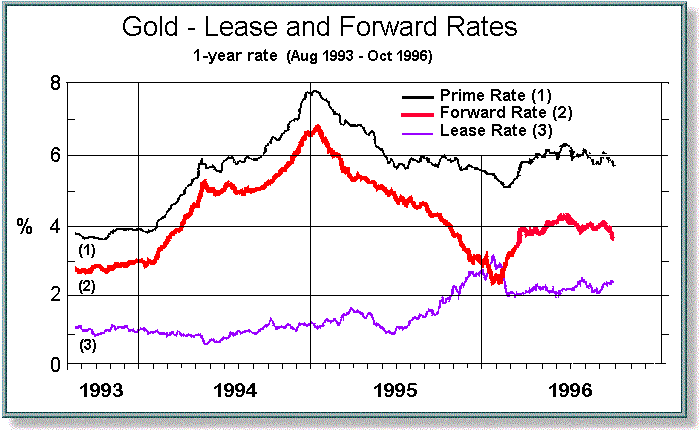
If the gold borrowing rate is 2 percent per annum, for example, then 100 ozs of gold borrowed for 360 days must be repaid as 102 ozs of gold. (Gold interest rates, like most money market rates, are nearly always quoted on the basis of a 360-day year.) In the early 1980s gold deposits rarely yielded over 1 percent, but in recent years have rarely yielded less than 1 percent. The chart below, from Kitco, shows gold lease rates from August 1993 to October 1996. (More recent daily quotes can be found at the Kitco web site.)

Because of large central bank gold holdings, gold loans are one of the cheapest financing sources for the gold mining industry. A mining company borrows gold and sells it on the spot market to obtain funds for gold production. The interest installments on the gold loan are payable in gold. And when the loan matures, the principal (and any final interest due) is repaid directly from mine production.

Central banks are the major lenders of gold. They accounted for around 75 percent of the gold on loan, estimated at around 2,750 tonnes, at the end of 1996. Central banks in recent years have been under pressure to earn a return on their gold holdings, and therefore lend to, for example, gold dealers who have mismatched books between gold deposits and gold loans. (The practice of central bank gold lending first became newsworthy in 1990, when the investment banking firm Drexel, Burnham, Lambert went bankrupt while owing borrowed gold to the Central Bank of Portugal.)

The gold lending (or borrowing) rate, then, is one of the components that determine the gold forward price. Let’s see how this works.
The Gold Forward Price

Suppose the spot price of gold is $300/oz. The gold lease rate for 180 days is 2 percent per annum. And the eurodollar rate for 180 days is 6 percent per annum. (For simplicity here, we ignore all bid-asked spreads. But they are easily included in the following calculations.)

I borrow $300 at the eurodollar rate. In 180 days I will have to repay the dollar borrowing with interest in the amount $300 (1+.06(180/360)) = $300 (1.03) = $309.

With the borrowed money I can buy 1 oz. of gold, and place it on deposit for 180 days. The amount of gold I will get back is 1 (1+.02(180/360) = 1 (1.01) = 1.01 oz.

Thus, 1 oz. of gold with a spot price of $300 has grown into 1.01 ounces in 180 days, with a value of $309. This translates into a 180-day forward value of $309/1.01 = $305.94.

Spot price: $300.00
180-day Forward Price: $305.94

Notice that both the gold lease and the eurodollar rate have gone into this calculation. Specifically:

$305.94 = $300 [1+.06 (180/360)] / [1+.02 (180/360)]. 

In general, if the spot price is S, the forward price is F(T) for a time-horizon of T days (up to a year), the eurodollar rate is r, and the gold lease rate is r*, we have the relation

F(T) = S [1 + r (T/360)] / [1 + r* (T/360)]. 

Notice that in the numerical example we just used, the forward price $305.94 is approximately 2 percent higher than the spot price of $300. That is, the 180- day forward premium of $5.94 is approximate 2 percent of the spot price of $300. (An exact 2 percent would be $6.) Why is this?

To see what is involved, let’s subtract the spot rate S from both sides of the above equation. The left- hand side will be the forward premium F(T) – S. Simplifying the right-hand side, we obtain:

F(T) - S = S [( r - r*)( T/360)] / [1 + r* (T/360)]. 

That is, the forward premium (F(T)-S) is approximately equal to the spot rate S multiplied by the difference between the eurdollar rate r and the gold lease rate r* (once we have adjusted this rate for the fraction of a year: T/360).

Since in the numerical example the eurodollar rate was 6 percent, while the least rate was 2 percent, the forward premium at an annual rate is approximately 6-2 = 4 percent. For 180 days, or half a year, it is approximately 2 percent.

So, as long as we are talking about an annual rate- -that is, before we do the days adjustment–the gold forward premium in percentage terms is approximately the difference between the eurodollar rate and the gold lease rate.

We can view this same relationship in other ways: given a eurodollar rate and a gold forward premium (in percentage terms), we can back out the implied lease rate.

Looking back at the chart from Kitco, above, it is easy to see that subtracting the gold lease rate from the “prime rate” gives us approximately the gold forward rate. (Note that “prime rate” is a misleading term to use: the relevant interest rate in the gold market is the eurodollar rate by which banks borrow and lend among themselves, not the commercial “prime” lending rate–which is often an administered, rather than a market, interest rate.)

Gold forward rates are sometimes referred to as “GOFO” rates, because GOFO was the Reuters page that showed gold forward rates.
Gold Swaps

There are many different hedging and trading operations in the gold market, all of which bring us back to the same relationship between forward and spot rates we saw in the previous section.

For example, gold dealers will buy gold forward from mining companies. The mining companies, thus assured of a fixed forward price at which to sell their production, go to work producing. Meanwhile, the gold dealers, to hedge themselves against movements in the gold price, borrow gold and sell it in the spot market. (To repeat, dealers “borrow” gold by taking in gold deposits, and paying out the gold lease rate.)

Restated, gold dealers buy gold forward from mining companies at a price F(T). To hedge themselves, the dealers borrow gold at an interest rate r*, and sell it in the market at a price S. They earn interest on the dollar proceeds of the spot gold sale at an interest rate r.

Thus, for each ounce of gold purchased, the dealer must pay

F(T) [1+ r* (T/360) ] . 

While for each ounce of gold sold, the dealer earns:

S [1 + r (T/360)]. 

All excess profit (beyond bid-asked spread) gets eliminated when these amounts are equal. Which gives

F(T) [1+ r* (T/360) ] = S [1 + r (T/360)] . 

This is, of course, exactly the same formula as before.

Generally speaking, gold dealers will quote forward prices to their customers (these are called “outright” forwards), but forward trades beween dealers mostly take place in connection with a simultaneous spot transaction. That is, in the form of “swaps.” A swap transaction is a spot sale of gold combined with a forward repurchase, or a spot purchase of gold combined with a forward sale. This type of trading requires less capital and is subject to less price risk. The swap rate is F(T)-S, and as we saw before, this difference is (when quoted as a percentage of the spot price) essentially the difference between the eurodollar rate and the gold lease rate.

A spot sale of gold combined with a forward purchase is also called a cash-and-carry transaction. The transaction provides immediate cash, the cost of which is the carry, or the difference between forward and spot rates. The dollar lender (who buys the gold), meanwhile has possession of the gold as security. So a cash-and-carry (one form of a swap) boils down to a dollar loan collateralized with gold.

The typical dealing spread between eurodollar deposits is 1/8 of 1 percent, or .125 percent, while the typical spread between gold deposit and loan rates is .20 percent. This translates into bid-asked swap rate, or cash-and-carry, spreads of about .30 percent. For example:

Eurodollar rates    Gold lease rates    Gold swap rates

1 month 3.0625-3.1875 0.50-0.70 2.35-2.65
3 months 3.1250-3.2500 0.55-0.75 2.40-2.70
6 months 3.3125-3.4375 0.70-0.90 2.45-2.75
12 months 3.5625-3.6875 1.00-1.20 2.35-2.65

Note that the gold swap rate can be independently viewed as the collateralized borrowing rate. A small central bank, for example, with plenty of gold to spare, could borrow dollars for 3 months and pay–not the 3-month asked eurodollar rate of 3.25 percent–but rather the gold swap rate of 2.70 percent.

(to be continued)

This article appeared in Laissez Faire City Times, Vol 2, No 19.
Web Page: http://www.aci.net/kalliste/

-30-

Posted on

The Gold Market, Part 2

The Gold Market
Part 2
by J. Orlin Grabbe

A few years ago I came across a copy of a speech by a well-known economist who was purporting to advise the government of Russia what they should to do stabilize the Russian money supply. The speech recommended they should “buy and sell gold on the London Metal Exchange.” Which made about as much sense as recommending that Hillary Clinton enhance her income by buying and selling cattle futures at the NYMEX.

Cattle futures aren’t traded at the NYMEX, and gold isn’t traded at the London Metal Exchange.

The London Bullion Market Association

The center of world gold trading is London, and the center of London gold and silver trading is the London Bullion Market, operated by the London Bullion Market Association (LBMA). Members are classified into market making members, which include all of the participants in the twice-daily London gold fix described in Part 1, as well as other bullion houses (for a total of 14), and ordinary members, of which there are about 50. Most bullion houses act both as brokers for customers, and as primary dealers who hold positions of their own in order to profit from the bid/asked spread or from equilibrium price movements.

Market makers are obligated to make two-way prices (that is, for both buying and selling) throughout the day. Ordinary dealers will usually quote prices to their own clients, but have no obligation to make two-way markets or to quote to other dealers.


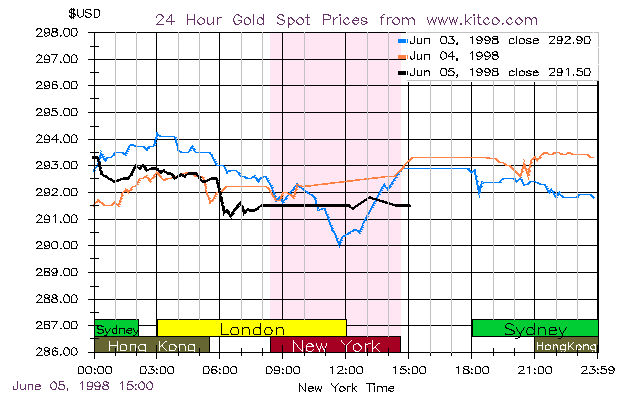
The fixing of the gold price starts at 10:30 a.m. in the morning (and lasts until a single price representing temporary equilibrium between supply and demand is found, usually a few minutes later), and again at 3:00 p.m. in the afternoon. (A silver price fixing takes place beginning at 12 noon.) During these time periods the fix is the principal focus of trading, but trading by the same firms occurs before and after the fix, and indeed gold trades around the world for almost 24 hours a day. The time overlaps between various trading centers can be seen in the daily gold price chart above from Kitco.

Most gold trading around the world takes place “loco London”, meaning the gold is sold for delivery in London.

The London Good Delivery Bar

The LMBA sets down standards for gold bars that can be accepted for “good delivery.” The London good delivery bar is a benchmark standard for spot (or physical) gold transactions. The requirements are:

Weight: 350-430 fine troy ounces
Fineness: minimum 995 parts per 1000 fine gold
Assayers/Melters Stamp: any approved by the LMBA
Obligatory Marks: a serial number and fineness, along
with an assayer and melter stamp of
weight to within .025 troy ounces
Appearance: must be of good appearance, free from
cavities, and easy to handle and stack
Delivery: usually takes place at one of the London
bullion clearing houses

Price quotations in the spot market are usually expressed in U.S. dollars, and are quoted as the price per fine troy ounce, such as:

$292.50-$292.80/oz

Here the bid or buying price is $292.50 per fine troy ounce, and the asked or selling price is $292.80 per fine troy ounce. Spot delivery will take place in terms of London good delivery bars on the spot date, which is the second working day after the trade date.

Although the price is quoted in dollars per ounce, all trades must take place in terms of so many gold bars, because physical delivery must take place in whole multiples of gold bars. The standard amount for a dealer spot price quotation is ten 400 oz. bars, or 4000 ozs. of gold. Thus if one purchased the standard amount at the dealer’s asked rate listed above, one would pay:

10 x 400 x $292.80 = $1,171,200

in two working days to the seller, and receive in return 4000 ozs. of gold at one of the bullion clearing houses.

London Clearing Houses

A buillion clearing house nets out gold transactions, much as banks do in trading foreign exchange. Only the net difference between total purchases and total sales vis-a-vis a counterparty is actually transferred. But a bullion clearing bank may take physical delivery of bullion, whereas a foreign exchange clearing bank only takes delivery of foreign exchange in the form of accounting entries (a checking balance at some foreign bank).

LMBA clearing houses include the Bank of England, the five dealers at the gold fixing, and a few other houses whose identities have varied from time to time. The number of clearing members is smaller than the number of market making members (8 versus 14), because the financial and other requirements are much stricter for clearing members.

The volume of precious metals cleared by the members of the LBMA has traditionally been kept confidential, but in January 1997 the LBMA released figures for the final (December) quarter of 1996. The average daily volume cleared between the (then) 14 market making members of the LBMA was approximately 933 tons (about $10 billion at prices then current), compared with annual global mine production of approximately 2,300 tons. That is, an amount equal to total annual gold production was cleared every 2.5 days. (The total amount of silver cleared daily was approximately 7,775 tons.)

Of course, because most gold is traded loco London, these clearing figures represent the result of worldwide gold trading, not just trading in London. Of the 933 tons cleared daily, it was estimated that about 218 tons represented London trades, while of the 7,775 tons of silver cleared daily, about 3,732 tons represented London trades.

Gold accounts at a bullion house may be allocated or unallocated. The unallocated account is most typical. One holds on deposit a specific number of ounces of gold, but these ounces of gold are not identified with any individual physical gold bars. These unallocated accounts may or may not bear interest, and may or may not have insurance and storage charges. All clearing accounts are unallocated accounts, and contain identical (hypothetical) 400 oz. bars.

Most gold trading takes place by paper transfers between unallocated accounts. Bookkeeping entries avoid the transactions costs and security risks of moving the actual metal. Traders clear their trades with one another through book entry transfers in or out of accounts at one or more clearing members, while clearing members clear their net trades with one another through their gold accounts at the Bank of England, as well as by physical gold transfers.

Allocated accounts, by contrast, contain individual gold bars with given serial numbers. In effect, allocated accounts are safe-keeping or custody accounts. Such accounts do not bear interest, are normally subject to charges, and may not be used as clearing accounts.

Transactions at the Fix

The London daily price fixings allow everyone to deal on equal terms, and large volumes to be transacted at a single price. In addition, the price is widely publicized, so it is undisputed. Once a price has been found such that net gold for sale (in 5 bar denominations–i.e., units of 2000 oz.) is equal to net gold for purchase, transactions then take place according to the following formula.

A seller on the fix receives the fixing price plus $.05 per ounce of gold (fix+.05). A buyer on the fix pays the fixing price plus $.25 per ounce of gold (fix+.25). This is equivalent to a market bid price of fix+.05, and a market asked price of fix+.25, for a total spread of $.20. This spread is narrower than the normal dealing spread, which is typically $.30 or higher.

Fixing orders may be placed in various ways.

Example 1: A market order. A client leaves an order to sell 20,000 ozs. at the PM fix.

Example 2: A price limit order. The client places an order to buy 25,000 ozs. at the AM fix, if the fixing price is at or lower than $290/oz.

Example 3: An average rate order. A client places at order to buy 10,000 ozs. at the average of the AM fixing price for July 1998. (Simple question in risk management: How will the firm manage this order?)

Example 4: Dynamic order. The client stays on the horn, listening to the fixing commentary, and changes his order according to the new fixing price being tried

(to be continued)

This article appeared in Laissez Faire City Times, Vol 2, No 18.
Web Page: http://www.aci.net/kalliste/

-30-

Posted on

The Gold Market, Part 1

The Gold Market
Part 1
by J. Orlin Grabbe

The gold market is a unique 24-hour-a-day market for the purchase or sale of one of history’s longest-valued commodities. What gives the market its special character is the use of gold simultaneously as industrial commodity, as decoration (jewelry), and as a monetary asset. To understand the gold market, it is important to understand the latter function. Because gold has often formed a component of the local money supply, its history is intertwined with national and central bank politics.

Gold as Money

Gold is only one of many commodities that over the years have served as money–as a medium of exchange–in international trade and financial transactions. Such commodities have frequently varied. In many local communities (including nation-states), the most widely used commodity, or the product most traded with outsiders, has often functioned as money. In the Oregon territory from 1830 to 1840, for example, beaver skins were a customary medium of exchange. Then, as the population shifted from fur trapping to farming, wheat became the chief form of money, and from 1840 to 1848 promissory notes were made payable in so many bushels of wheat. Later, with the California gold discoveries in 1848, the Oregon legislature repealed the law making wheat legal tender, and proclaimed that thereafter only gold and silver were to be used to settle taxes and debts. For similar reasons, tobacco long served as the principal currency in Virginia. When the Virginia Company imported 150 “young and uncorrupt girls” as wives for the settlers in 1620 and 1621, the price per wife was initially 100 pounds of tobacco–later climbing to 150 pounds.

Only a few currencies, however, have had long-run durability as well as multi-territorial acceptability. Silver and gold are two of these. Roughly speaking, from the time of Columbus’ discovery of America in 1492 to the California gold discovery in 1848, silver dominated in common circulation in America and Europe, while gold came into dominance following the Californian and Australian gold discoveries (see Chapter 8 in J. Laurence, The History of Bimetallism in the United States, D. Appleton and Company, 1901). Under the rule of the British Empire, the British pound sterling and the gold standard were adopted in much of the world. Toward the end of World War Two, the U.S. dollar and gold became the principal international reserve assets under the Bretton Woods agreement–a market position the U.S. dollar and gold have maintained despite the de facto dissolution of that system in the early 1970s.

The Post-WW2 Politics of Gold

Under the Bretton Woods Agreement forged at the Mt. Washington Hotel in Bretton Woods, New Hampshire in 1944, each member of the newly created International Monetary Fund (IMF) agreed to establish a par value for its currency, and to maintain the exchange rate for its currency within 1 percent of par value. In practice, since the principal reserve currency would be the U.S. dollar, this meant that other countries would peg their currencies to the U.S. dollar, and–once convertibility was restored–would buy and sell U.S. dollars to keep market exchange rates within the 1 percent band around par value. The United States, meanwhile, separately agreed to buy gold from or sell gold to foreign official monetary authorities at $35 per ounce in settlement of international financial transactions. The U.S. dollar was thus pegged to gold, and any other currency pegged to the dollar was indirectly pegged to gold at a price determined by its par value.

What does it mean to fix the price (the exchange value) of a currency or a commodity like gold? If no trading other than with official authorities is allowed (as when something is “inconvertible”), then fixing the price is easy. The central bank or exchange authority simply says the price is “X” and no one can say differently. If you want to trade gold for dollars, you have to deal with the central bank, and you have to trade at central bank prices. The central bank may in fact even refuse to trade with you, but it can still maintain the lawyerly notion that the exchange rate is “fixed.” (Such a refusal, of course, will only lead to black market trading outside official channels.) If, however, free trade is allowed, fixing the price requires a great deal more. The price can be fixed only by altering either the supply of or the demand for the asset. For example, if you wanted to fix the price of gold at $35 per ounce, you could only do so by being willing and able to supply unlimited amounts of gold to the market to drive the price back down to $35 per ounce whenever there would otherwise be excess demand at that price, or to purchase unlimited amounts of gold from the market to drive the price back up to $35 per ounce whenever there would otherwise be excess supply at that price.

In order to peg the price of gold you would thus need two things: a large stock of gold to supply to the market whenever there is a tendency for the market price of gold to go up, and a large stock of dollars with which to purchase gold whenever there is a tendency for the market price of gold to go down. No problem. The U.S. had plenty of gold–about 60 percent of the world’s stock. And, naturally, it also had plenty of dollars, which could be created with the stroke of a pen.

After the Bretton Woods Agreement, the price of gold remained uncontroversial for the next decade. But around 1960 the private market price of gold began to show a persistant tendency to rise above its official price of $35/ounce. So, in the fall of 1960, the United States joined with the central banks of the Common Market countries as well as with Great Britain and Switzerland to intervene in the private market for gold. If the private market price did not rise above $35 per ounce, it was felt, the Bretton Woods price was de facto the correct price, and in addition no one could complain if dollars were not exchangeable for gold. This coordinated intervention, which involved maintaining the gold price within a narrow range around $35 per ounce, became formalized a year later as the gold pool. Since London was the center of world gold trading, the pool was managed by the Bank of England, which intervened in the private market via the daily gold price fixing at N. M. Rothschild.

The London Gold Fixing

In its current form, the London gold price fixing takes place twice each business day, at 10:30 A.M. and 3:00 P.M. in the “fixing room” of the merchant banking firm of N. M. Rothschild. Five individuals, one each from five major gold-trading firms, are involved in the fixing. The firms represented are Mocatta & Goldsmid, a trading arm of Standard Chartered Bank; Sharps Pixley, a dealer owned by Deutsche Bank; N. M. Rothschild & Sons, whose representative acts as the auctioneer; Republic-Mase, a bullion subsidiary of Republic Bank; and Samuel Montagu, a merchant banking subsidiary of Midland Bank (owned by HSBC). Each representative at the fixing keeps an open phone line to his firm’s trading room. Each trading room in turn has buy and sell orders, at various prices, from customers located all over the world. In addition, there are customers with no existing buy or sell orders who keep an open line to a trading room in touch with the fixing and who may decide to buy or sell depending on what price is announced. The N. M. Rothschild representative announces a price at which trading will begin. Each of the five individuals then confers with his trading room, and the trading room tallies up supply and demand–in terms of 400-ounce bars– from orders originating around the world. In a few minutes, each firm has determined if it is a net buyer or seller of gold. If there is excess supply or demand a new price is announced, but no orders are filled until an equilibrium price is determined. The equilibrium price, at which supply equals demand, is referred to as the “fixing price.” The A.M. and P.M. fixing prices are published daily in major newspapers.

Even though immediately before and after a fixing gold trading will continue at prices that may vary from the fixing price, the fixing price is an important benchmark in the gold market because much of the daily trading volume goes through at the fixing price. Hence some central banks value their gold at an average of daily fixing prices, and industrial customers often have contracts with their suppliers written in terms of the fixing price. Since a fixing price represents temporary equilibrium for a large volume of trading, it may be subject to less “noise” than are trading prices at other times of the day. Usually the equilibrium fixing price is found rapidly, but sometimes it takes twenty to thirty tries. Once in October 1979, with supply and demand fluctuating rapidly from moment to moment, the afternoon fixing in London lasted an hour and thirty-nine minutes.

The practice of fixing the gold price began in 1919. It continued until 1939, when the London gold market was closed as a result of war. The market was reopened in 1954. When the central bank gold pool began officially in 1961, the Bank of England–as agent for the pool–maintained an open phone line with N. M. Rothschild during the morning fixing (there was as yet no afternoon fixing). If it appeared that a fixing price would be established that was above $35.20 or below $34.80, the Bank of England (as agent) became a seller or buyer of gold in an amount sufficient to ensure that the fixing price remained within the prescribed bands.

Gold and European Union

While the gold pool held down the private market price of gold, gold politics took a new turn in the international arena. This was related to the fact that European countries, which had complained of a “dollar shortage” in the 1950s, where now complaining of a “dollar glut.” They were accumulating too many dollar reserves. Although it was actually Germany that was running the greatest surplus and accumulating the most dollar reserves in the early 1960s, it was France under the leadership of Charles de Gaulle that made the most noise about it. During World War II, in conversations with Jean Monnet, de Gaulle had supported the notion of a united Europe–but a Europe, he insisted, under the leadership of France. After the war, France had opposed the American plan for German rearmament even in the context of European defense. France had been induced to agree, however, through Marshall Plan aid, which France was not inclined to refuse after it became embroiled in the Indo-China War. But now, in the 1960s, de Gaulle’s vision of France as a leading world power led him to withdraw from NATO because NATO was a U.S.-dominated military alliance. It also led him to oppose Bretton Woods, because the international monetary system was organized with the U.S. dollar as a reserve currency.

In the early 1960s there was, however, no realistic alternative to the dollar as a reserve asset, if one wanted to keep reserves in a form that both would bear interest and could be traded internationally. Official dollar-reserve holders not only were made exempt from the interest ceilings of the Federal Reserve’s Regulation Q for their deposits in New York but also began as a regular practice to hold dollars in the eurodollar market–a free market where interest rates found their own level. Prior to 1965, central banks were the largest suppliers of dollars to the euromarket. Thus dollar reserve holders received a competitive return on their dollar assets, and the United States gained no special benefit from the use of the dollar as a reserve asset.

Nevertheless, de Gaulle’s stance on gold made domestic political sense, and in February 1965, in a well-publicized speech, he said: “We hold as necessary that international exchange be established . . . on an indisputable monetary base that does not carry the mark of any particular country. What base? In truth, one does not see how in this respect it can have any criterion, any standard, other than gold. Eh! Yes, gold, which does not change in nature, which is made indifferently into bars, ingots and coins, which does not have any nationality, which is held eternally and universally. . . .” By the “mark of any particular country” he had in mind the United States, which announced the Foreign Credit Restraint Program about a week later, in part as a direct response to de Gaulle’s speech. France stepped up its purchases of gold from the U.S. Treasury and in June 1967, when the Arab-Israeli Six-Day War led to a large increase in the demand for gold, withdrew from the gold pool.

The Two-Tier System

Then in November 1967, the British pound sterling was devalued from its par value of $2.80 to $2.40. Those holding sterling reserves took a 14.3 percent capital loss in dollar terms. This raised the question of the exchange rate of the other reserve assets: if the dollar was to be devalued with respect to gold, a capital gain in dollar terms could be made by holding gold. Therefore demand for gold rose and, as it did, gold pool sales in the private market to hold down the price were so large that month that the U.S. Air Force made an emergency airlift of gold from Fort Knox to London, and the floor of the weighing room at the Bank of England collapsed from the accumulated tonnage of gold bars.

In March 1968, the effort to control the private market price of gold was abandoned. A two-tier system began: official transactions in gold were insulated from the free market price. Central banks would trade gold among themselves at $35 per ounce but would not trade with the private market. The private market could trade at the equilibrium market price and there would be no official intervention. The price immediately jumped to $43 per ounce, but by the end of 1969 it was back at $35. The two-tier system would be abandoned in November 1973, after the emergence of floating exchange rates and the de facto dissolution of the Bretton Woods agreement. By then the price had reached $100 per ounce.

When the gold pool was disbanded and the two-tier system began in March 1968, there was a two-week period during which the London gold market was forceably closed by British authorities. A number of important changes took place during those two weeks. South Africa as a country was the single largest supplier of gold and had for years marketed the sale of its gold through London, with the Bank of England acting as agent for the South African Reserve Bank. With the breakdown of the gold pool, South Africa was no longer assured of steady central bank demand, and–with the London market temporarily closed–the three major Swiss banks (Swiss Bank Corporation, Swiss Credit Bank, and Union Bank of Switzerland) formed their own gold pool and persuaded South Africa to market through Zurich.

In 1972, the second major country supplier of gold, the Soviet Union, also began to market through Zurich. In 1921, V. I. Lenin had written, “sell [gold] at the highest price, buy goods with it at the lowest price.” Since the Soviet ruble was not convertible, the Soviet Union used gold sales as one major source of its earnings of Western currencies, and in the 1950s and 1960s sold gold through the Moscow Narodny in London (a bank that had also provided dollar cover for the Soviets during the early days of the Cold War). In Zurich, the Soviet Union dealt gold via the Wozchod Handelsbank, a subsidiary of the Soviet Foreign Trade Bank, the Vneshtorgbank. (In March 1985, the Soviet Union announced that the Wozchod would be closed because of gold-trading losses and would be replaced with a branch office of the Vneshtorgbank. The branch office, unlike the Wozchod, would not be required to publish information concerning operations.)

London, in order to stay competitive, subsequently turned itself more into a gold-trading center than a distribution center. When the London market reopened in March 1968 after the two-week “holiday,” a second daily fixing (the 3:00 P.M. fixing) was added in order to overlap with U.S. trading hours, and the fixing price was switched to U.S. dollar terms from pound sterling terms. But by the 1980s, London’s new role as a trading center had begun to be challenged by the Comex gold futures market in New York.

The SDR as “Paper Gold”

During the early years of the gold pool, it came to be believed that there was a deficiency of international reserves and that more reserves had to be created by legal fiat to enable reserve-holders to diversify out of the U.S. dollar and gold. In retrospect, this was a curious view of the world. The form in which reserves are held will ultimately always be determined on the basis of international competition. People will hold their wealth in the form of a particular asset only if they want to. If they do not have an economic incentive to desire a particular asset, no legal document will alter that fact. A particular currency will be attractive as a reserve asset if these four criteria exist: (1) an absence of exchange controls so people can spend, transfer, or exchange their reserves denominated in that currency when and where they want them; (2) an absence of applicable credit controls and taxes that would prevent assets denominated in the currency from bearing a competitive rate of return relative to other available assets; (3) political stability, in the sense that there is a lack of substantial risk that points (1) and (2) will change within or between government regimes; (4) a currency that is in sufficient use internationally to limit the costs of making transactions. These four points explain why, for example, the Swiss but not the French franc has been traditionally used as an international reserve asset.

Many felt that formal agreement on a new international reserve asset was nevertheless needed, if only to reduce political tension. And while France wanted to replace the dollar as a reserve asset, other nations were looking instead for a replacement for gold. The decision was made by the Group of Ten (ten OECD nations with most of the voting rights in the IMF) to create an artificial reserve asset that would be traded among central banks in settlement of reserves. The asset would be kept on the books of the IMF and would be called a Special Drawing Right (SDR). In fact it was a new reserve asset, a type of artificial or “paper gold,” but it was called a drawing right by concession to the French, who did not want it called a reserve asset.

The SDR was approved in July 1969, and the first “allocation” (creation) of SDRs was made in January l970. Overnight, countries gained more reserves at the IMF, because the IMF added new numbers to its accounts and called these numbers SDRs. The timing of the allocation was especially maladroit. In the previous four years the United States had been in the process of financing the Great Society domestic social programs of the Johnson administration as well as a war in Vietnam, and the world was being flooded with more reserves than it wanted at the going price of dollars for deutschemarks, yen, or gold. In the 1965 Economic Report of the President, Johnson wrote, in reference to his Great Society Program and the Vietnam War: “The Federal Reserve must be free to accommodate the expansion in 1965 and the years beyond 1965.” U.S. money supply (M1) growth, which had averaged 2.2 percent per year during the 1950s, inched upward slightly during the Kennedy years (2.9 percent per year for 1961- 1963) but changed materially under the Johnson administration. The growth rate of M1 averaged 4.6 percent per year over 1964-1967, then rose to 7.7 percent in 1968. Under the Nixon administration that followed, money growth initially slowed to 3.2 percent in 1969 and 5.2 percent in 1970, then accelerated to 7.1 percent for 1971-1973. The latter three years would encompass the breakdown of Bretton Woods, and would also have a material effect on the price of gold.

How Foreign Exchange Intervention Affects the Money Supply

In order to succeed, a regime of fixed exchange rates (and under Bretton Woods, rates for the major currencies were fixed in terms of their par values, which could not be casually altered) requires coordinated economic policies, particularly monetary policies. If two different currencies trade at a fixed exchange rate and one currency is undervalued with respect to the other, the undervalued currency will be in excess demand. By the end of the 1960s both the deutschemark and the yen had become undervalued with respect to the U.S. dollar. Therefore the countries concerned (Germany and Japan) had two choices: either increase the supplies of their currencies to meet the excess demand or adjust the par values of their currencies upward enough to eliminate the excess demand.

As long as either country intervened in the market to maintain the par value of its currency with respect to the U.S. dollar, an increased supply of the domestic currency would take place automatically. To see why this is so, take the case of Germany. In order to keep the DM from increasing in value with respect to the U.S. dollar, the Bundesbank would have to intervene in the foreign exchange market to buy dollars. It would buy dollars by selling DM. The operation would increase the supply of DM in the market, driving down DM’s relative value, and increase the demand for the dollar, driving up the dollar’s relative value.

Any time the central bank intervenes in any market to buy or sell something, it potentially changes the domestic money supply. If the central bank buys foreign exchange, it does so by writing a check on itself–by giving credit to the seller. Central bank assets go up: the central bank now owns the foreign exchange. But central bank liabilities go up also, since the check represents a central bank liability. The seller of the foreign exchange or other asset will deposit the central bank’s check, in payment for the value of the assets, in an account at a commercial bank. The commercial bank will in turn deposit the check in its account at the central bank. The commercial bank will now have more reserves, in the form of a deposit at the central bank. The bank can use the reserves to make more loans, and the money supply will expand by a multiple of the initial reserve increase.

Is there anything the German authorities can do to prevent the money- supply increase? Essentially not, as long as they attempt to maintain the fixed exchange rate. There is, however, an operation referred to as sterilization. Sterilization refers to the practice of offsetting any impact on the monetary base caused by foreign exchange intervention, by making reverse transactions in terms of domestic assets (such as government bonds). For example, if the money base went up by DM4 billion because the central bank bought dollars in the foreign exchange market, a sterilization operation would involve selling DM4 billion worth of domestic assets to reduce central bank liabilities by an equal and offsetting amount. If the Bundesbank sold domestic assets, these would be paid for by checks drawn on the commercial banking system and reserves would disappear as the commercial banks’ checking accounts were debited at the central bank.

However, the Bundesbank could not simultaneously engage in complete sterilization (a complete offset) and also maintain the fixed exchange rate. If there was no change in the supply of DM, the DM would continue to be undervalued with respect to the dollar, and foreign exchange traders would continue to exchange dollars for DM. During the course of 1971, the Bundesbank intervened so much that the German high-powered money base would have increased by 42 percent from foreign exchange intervention alone. About half this increase was offset by sterilization, but, even so, the increase in the money base–and eventually the money supply–by more than 20 percent in one year was enormous by German standards. The breakdown of the Bretton Woods system began that year.

The Breakdown of Bretton Woods

It came about this way. From the end of World War II to about 1965, U.S. domestic monetary and fiscal policies were conducted in such a way as to be noninflationary. As world trade expanded during this period, the relative importance of Germany and Japan grew, so that by the end of the 1960s it was unreasonable to expect any system of international finance to endure without a consensus at least among the United States, Germany, and Japan. But after 1965, U.S. economic policy began to conflict with policies desired by Germany and Japan. In particular, the United States began a strong expansion, and moderate inflation, as a result of the Vietnam War and the Great Society program.

When it became obvious that the DM and yen were undervalued with respect to the dollar, the United States urged these two nations to revalue their currencies upward. Germany and Japan argued that the United States should revise its economic policy to be consistent with those in Germany and Japan as well as with previous U.S. policy. They wanted the United States to curb money- supply growth, tighten credit, and cut government spending. In the ensuing stalemate, the U.S. policy essentially followed the recommendations of a task force chaired by Gottfried Haberler. This was a policy of officially doing nothing and was commonly referred to as a policy of “benign neglect.” If Germany and Japan chose to intervene to maintain their chosen par values, so be it. They would be allowed to accumulate dollar reserves until such time as they decided to change the par values of their currencies. That was the only alternative if the United States would not willingly change its policy. It was clearly understood at the time that a unilateral action on the part of the United States to devalue the dollar by increasing the dollar price of gold would be matched by similar European devaluations.

In April 1971, the Bundesbank took in $3 billion through foreign exchange intervention. On May 4 it took in $1 billion in the course of the day. On May 5 the Bundesbank took in $1 billion during the first hour of trading, then suspended intervention in the foreign exchange market. The DM was allowed to float upward. On August 15 the U.S. president, Nixon, suspended the convertibility of the dollar into gold and announced a 10 percent tax on imports. The tax was temporary and was intended to signal the magnitude by which the United States thought the par values of the major European and Japanese currencies should be changed.

An attempt was made to keep the Bretton Woods system going by a revised agreement, the Smithsonian agreement, reached at the Smithsonian Institution in Washington on December 17-18, 1971. Called by President Nixon “the most important monetary agreement in the history of the world,” it lasted only slightly more than a year, but beyond the 1972 U.S. presidential election. At the Smithsonian Institution the Group of Ten agreed on a realignment of currencies, an increase in the official price of gold to $38 per ounce, and expanded exchange rate bands of 2.25 percent around their new par values.

Over the period February 5-9, 1973, history repeated itself, with the Bundesbank taking in $5 billion in foreign exchange intervention. On February 12, exchange markets were closed in Europe and Japan, and the United States announced a 10 percent devaluation of the dollar. European countries and Japan allowed their currencies to float and, over the next month, a de facto regime of floating exchange rates began. The floating rate system has persisted to the present, with none of the five most widely traded currencies (the dollar, the DM, the British pound, the Japanese yen, the Swiss franc) in any way officially fixed in exchange value with respect to the others. (Briefly, from October 1990 to September 1992, the DM and the British pound were nominally linked in the Exchange Rate Mechanism of the European Monetary System.) With the breakdown of Bretton Woods, there began a slow dismantling of the array of controls that had been erected in its name. This included gold.

As part of the Jamaica agreement in 1976 (which ludicrously proclaimed a “New International Economic Order”), IMF members agreed to demote the role of gold. But few central banks subsequently followed up this agreement in practice. One associated change that did come about, however, affected the private gold market in the United States. On January 2, 1975, after forty years of prohibition, U.S. citizens were allowed to purchase gold bullion legally. The Comex in New York subsequently became an important center for the trading of gold futures.

(to be continued)

This article appeared in Laissez Faire City Times, Vol 2, No 16.
Web Page: http://www.aci.net/kalliste/

-30-
